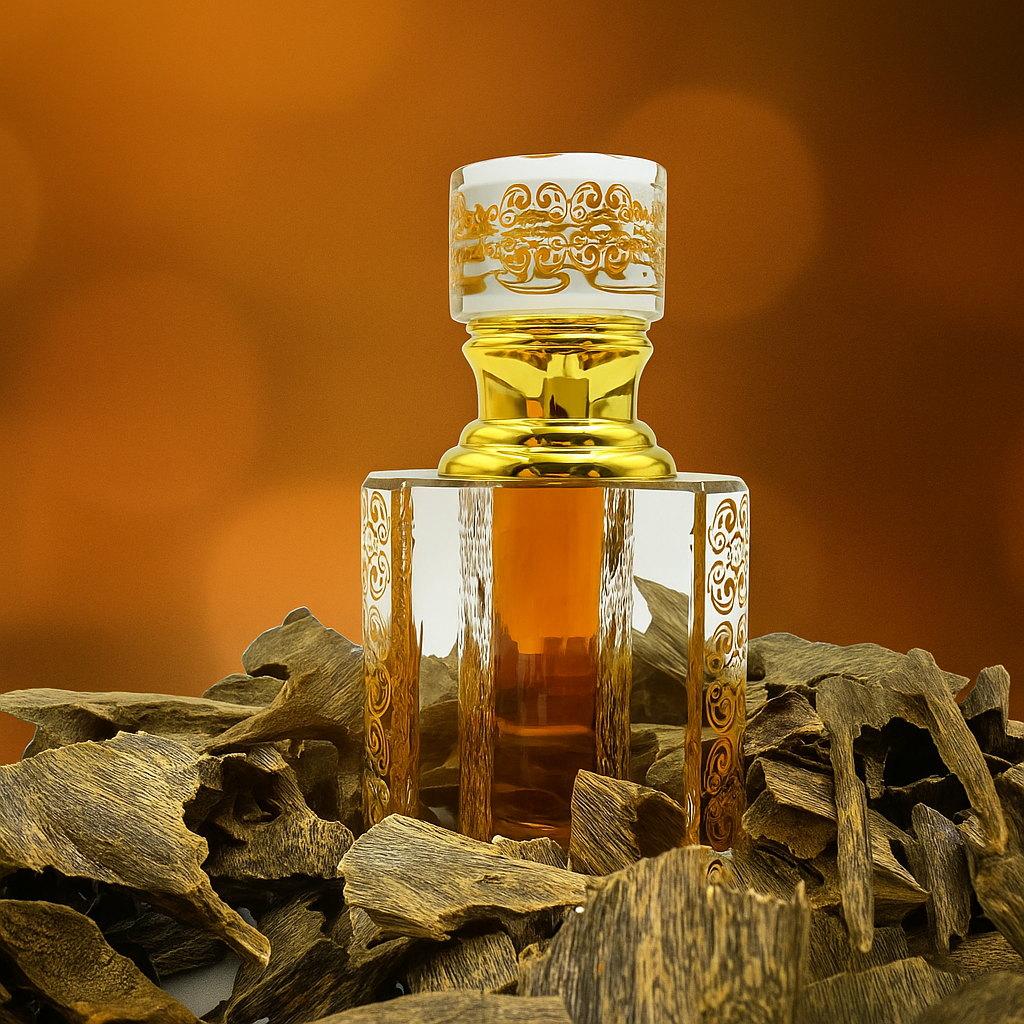
Oud from China Hainan
Hainan Oud
'Citrinitas' - Pure Oud Oil from Hainan 5 ml
Share

🌿 Chinese Agarwood — The Fragrance of a Thousand Years
“An ounce of agarwood is worth its weight in gold —Deep in the forest, the fragrance lingers in silence.”
— Ancient Chinese saying
I · Origins Through Time — The Journey of Fragrance
Among all the precious gifts of nature, agarwood (Chinese: 沉香, Chen Xiang) stands apart.
It is more than a kind of wood — it is a crystallization of time, nature, and culture.
The earliest written records of agarwood in China trace back to the Eastern Han dynasty (25–220 AD).
In ancient texts such as Han Palace Fragrance Formulas, agarwood was described as an imperial incense used in court rituals and Buddhist temples. The Chinese name “Chen Xiang” literally means “sinking fragrance” — referring both to the wood’s density (it sinks in water) and to its deep, enduring aroma.
By the Tang and Song dynasties, agarwood had become a symbol of refinement and spirituality.
Poets burned incense while composing verses; monks used it to purify temples; nobles treasured it as a luxury beyond gold. The saying “A fine piece of agarwood is worth ten thousand coins” reflected its priceless reputation.
Agarwood also entered myth and legend. In the classical story The Magic Lotus Lantern (宝莲灯), the hero “Chen Xiang” — whose name literally means “Agarwood” — split a mountain to rescue his mother. Over time, the name itself became a symbol of filial piety, perseverance, and sacred fragrance.
From Buddhist rituals to scholars’ studies, from royal palaces to quiet monasteries, agarwood became an inseparable part of Chinese spiritual life, carrying within it the delicate essence of civilization itself.
II · Birthplace of Fragrance — Where the Wood Breathes
Agarwood is not grown; it is born from adversity.
It forms when the heartwood of Aquilaria sinensis trees is naturally injured — by insects, storms, lightning, or fungus.
In response, the tree produces resin to heal itself; over years or decades, this resin hardens inside the wood, giving rise to dark, aromatic agarwood.
● Hainan — The Heart of Chinese Agarwood
Hainan Island, at latitude 18° N, is China’s most famous agarwood region.
Its tropical monsoon climate, red basaltic soil, high humidity, and abundant rainfall make it the ideal cradle for Aquilaria sinensis.
Ancient records already praised “Qiongzhou’s extraordinary fragrance.”
Even today, the rainforests of Hainan — lush, mineral-rich, and ever-humid — produce agarwood of unmatched purity and resin content.
● Guangdong & Guangxi — The Lingnan Heritage
In the southern provinces of Guangdong and Guangxi, coastal mountains nurture another lineage of agarwood.
In historical Dongguan, locals once called it “Daughter’s Fragrance” (Nü’er Xiang), as women wore agarwood pendants for good fortune and grace.
● Ecology and Time
For agarwood to form, nature must provide the perfect harmony of climate, soil, and patience:
tropical rainforests, mineral-rich red earth, constant moisture, and the quiet passing of decades.
Only under these rare circumstances can a tree’s wound be transformed into a treasure of scent.
Thus, the geography of agarwood is not merely about land — it is a collaboration between earth, air, and time.
III · The Character and Value of the “King of Fragrance”
Agarwood has long been honored as “the King of Incense” and “the Soul of Wood.”
Its value stems from three intertwined dimensions: its natural rarity, sensory excellence, and cultural symbolism.
1. Physical and Chemical Perfection
High-grade agarwood contains rich resin and aromatic oils.
The resin-filled wood becomes denser than water, allowing it to sink — hence its name, “Chen Xiang”, or “Sinking Fragrance.”
Its volatile compounds create complex layers of scent, from sweet and woody to warm, smoky, and balsamic.
2. The Fragrance Itself
When gently heated or distilled, agarwood releases an aroma that shifts through many moods:
a top note of forest rain, a heart note of ambered sweetness, and a base of deep serenity.
Ancient Chinese medicine described its effects as “calming the mind and regulating the breath.”
To scholars and monks, burning agarwood was an act of purification — of space and of spirit.
3. Cultural and Spiritual Symbolism
In traditional Chinese aesthetics, fragrance equals virtue — invisible yet profound.
Agarwood became a metaphor for integrity and inner refinement.
It accompanied tea ceremonies, calligraphy sessions, and Buddhist offerings.
By the Ming dynasty, owning agarwood was a mark of taste and intellect — the fragrance of the wise.
4. Economic and Artistic Value
Because of its extreme rarity and slow formation, a single piece of wild agarwood could be worth more than gold.
In today’s world, agarwood continues to hold immense economic value — both as a high-end incense and a collectible art form.
It is carved into beads, pendants, sculptures, and burned in temples or private incense ceremonies.
However, overharvesting has made wild agarwood increasingly scarce.
Artificial cultivation and resin-inducing techniques are being developed, but the authentic, time-forged aroma of wild agarwood remains irreplaceable.
It is, quite literally, the scent of time made visible.
🌿 JIANFENGLING AGARWOOD
— The Natural Fragrance Born in the Rainforests of Hainan Island, China —
“Heaven and earth have spirit; wood and stone hold fragrance.
Time flows endlessly — only purity endures.”
At the southernmost edge of China, where ocean winds meet tropical rainforests, lies a land both ancient and mysterious — Jianfengling, deep within Hainan Island.
Located near latitude 18° N, it is one of the few remaining pristine tropical rainforests in all of Asia.
Mist veils the treetops year-round; the air is cool and moist; sunlight filters through towering canopies, glimmering on layers of fallen leaves — breathing green life into the forest.
Here grows one of China’s most precious trees — Aquilaria sinensis, the source of agarwood.
Jianfengling Agarwood carries the breath of the earth and the memory of time.
Every piece of wood and every drop of oil is not crafted by human hands, but sculpted by nature and the passing of years.
I · ORIGIN · The Heart of the Rainforest
The Jianfengling National Nature Reserve lies between Ledong and Dongfang counties in Hainan.
Its altitude ranges from hundreds to over a thousand meters, with mountain ridges stretching endlessly.
The region’s tropical monsoon climate keeps the annual average temperature near 23 °C, and humidity above 90%.
Rain is abundant yet never stagnant; sunshine is bright yet gentle; day-night temperature difference is small — making this forest a natural cradle for fragrant wood.
The soil, rich red loam and basalt, abounds in iron, manganese, and calcium.
Deep, porous earth and perfect drainage allow agarwood roots to anchor deep into the mountain veins, absorbing nutrients from decaying leaves — creating resin of remarkable density and complexity.
Here, no trees are wounded or forced to produce resin.
Only when wind, rain, insects, or lightning scar the trunk does the tree secrete resin to heal itself.
Over years or decades, that resin condenses and darkens, slowly becoming agarwood — a solemn meditation of nature.
“The fragrance of Jianfengling is not man-made but heaven-born —
a tree’s quiet answer to life, nature’s way of healing itself.”
II · HERITAGE · A Thousand Years of Fragrant Legacy
Hainan’s agarwood heritage traces back to the Tang and Song dynasties.
The Tang text Ling Biao Lu Yi recorded: “In Qiongzhou grows fragrant wood; when burned, its smoke is clear and soothing, calming the soul.”
By the Song era, Hainan agarwood was an imperial tribute; in Ming and Qing times, Jianfengling incense traveled across the South Seas, honored as the “King of Southern Fragrance.”
A legend tells of a scholar who journeyed to Jianfengling seeking incense.
He dreamt of an old man calling himself the “Spirit of Fragrance.”
Awakening, the scent still lingered; he wrote:
“A single wisp of true fragrance reaches the heavens;
A drop of divine dew endures for a thousand years.”
Thus the name Jianfeng Fragrance became a symbol of Hainan’s aromatic culture.
Compared with agarwood from Vietnam or Cambodia, Hainan’s is softer and more enduring — carrying a distinctive “rainforest freshness.”
Its scent combines the sweetness of forest soil with the clarity of mountain mist: gentle, profound, and elegantly restrained.
III · SPIRIT · Natural · Pure · Untouched
Guided by the principle “Created by Nature, Pure as One,”
Jianfengling Agarwood believes that true fragrance should never be diluted, modified, or masked.
Every drop of oil is distilled from naturally matured resin wood using traditional copper stills.
The slow, low-temperature process lasts 72 hours, relying only on mountain spring water — no chemical catalysts, no artificial essences.
When the golden oil droplet slides from the glass coil, it is the tear of time;
when its vapor rises, it is nature’s sigh.
“We do not manufacture fragrance —
we simply help nature complete her art.”
This conviction defines the founder’s lifelong philosophy.
IV · STORY · From Forest to Heart
The founder was born into a family of Hainan incense farmers.
Since childhood he learned to recognize trees by scent.
Understanding that agarwood’s worth lies not in rarity but in its spiritual resonance with nature,
he returned to his homeland after years away and rebuilt a copper distillery deep within the forest —
working only with wood, spring water, patience, and respect.
The brand’s emblem traces the outline of the Jianfeng mountains —
a curve flowing from high peaks to the sea, symbolizing the movement of fragrance and the balance between man and nature.
“Fragrance flows from the mountains;
the heart widens with the sea.”
V · CHARACTER · Tone and Spirit of the Scent
The scent of Jianfengling Agarwood reveals itself in delicate layers:
Top Note – Fresh and cool, evoking forest rain, resin, and moss.
Heart Note – Soft and honeyed, smooth as wax, gentle yet profound.
Base Note – Deep and tranquil, like evening wind through trees, lingering endlessly.
It is not loud or fleeting; rather, it quiets the soul, guiding one back to inner balance.
“To smell it is to walk through the rainforest after rain;
to breathe it is to speak with time itself.”
This is not a perfume to be made —
it is a soul patiently awaited.
VI · EPILOGUE · The Echo of Nature
Jianfengling Agarwood embodies the Eastern spirit of serenity and sincerity.
It rejects artifice and noise,
relying only on the quiet power of nature to move the heart.
Every drop of oil, every piece of wood,
is a breath of the mountains, a whisper of the earth, a gift of time itself.
When you light a piece of Jianfengling Agarwood and close your eyes,
you may hear the chorus of rain and birds —
a scent not born from wood,
but from the oldest language between heaven and earth: the echo of nature.
JIANFENGLING AGARWOOD
Let fragrance return to time.
Let the heart return to nature.
-
'Albedo' - Pure Oud Oil from Hainan 5ml
Regular price $198.00 USDRegular priceUnit price / perSale price $198.00 USD -
'Citrinitas' - Pure Oud Oil from Hainan 5 ml
Regular price $188.00 USDRegular priceUnit price / per$298.00 USDSale price $188.00 USDSale -
'Nigredo' -Pure oud Oil from Hainan 5 ml
Regular price $129.00 USDRegular priceUnit price / perSale price $129.00 USD -
'Rubedo' - Pure Oud Oil from China Hainan 5ml
Regular price $789.00 USDRegular priceUnit price / perSale price $789.00 USD